

AI as the Great Attenuator
On how AI is on both sides of the variety equation
“In an information-rich world, the wealth of information means a dearth of something else: a scarcity of whatever it is that information consumes. What information consumes is rather obvious: it consumes the attention of its recipients. Hence a wealth of information creates a poverty of attention.”
Herbert A. Simon, “Designing Organizations for an Information-Rich World” (1971)
The mid-2020s have become the ideal test-bed for an experiment that Stafford Beer envisioned decades earlier.
An institution that buys a computer uses it “at enormous cost, to do more elaborately exactly what was done before, the things we know that didn’t work.”
Stafford Beer, Designing Freedom (Massey Lectures, 1973)
In the previous article I introduced the law of requisite variety, and there is no better way to illustrate it than with AI, which is now at the core of every knowledge worker’s daily work. The question is whether it is a net positive or a net negative for our world.
This is a complex topic, and I don’t want to reduce it to a single narrative, but we have to start somewhere. Any discussion of AI’s overall contribution to our world, current or potential, must involve unemployment, fake news and much else. I will leave these for future posts.
For now, let’s go back to ordinary office work. A ton of incoming variety lands on our desks and in our heads, in the form of e-mails, messages, reports, support tickets and software code, among all the other artifacts of the digital office. More and more of it is generated by other people (and even systems) using AI, many of them probably becoming meat proxies. Without AI we would already be doomed, since our variety could never match all that and still leave room for our actual work. We would spend all our time reading and making sense of the noise, summarising it and extracting what matters. Fortunately, we have AI too, and we use it to “attenuate” the incoming variety. AI is doing work on both sides:
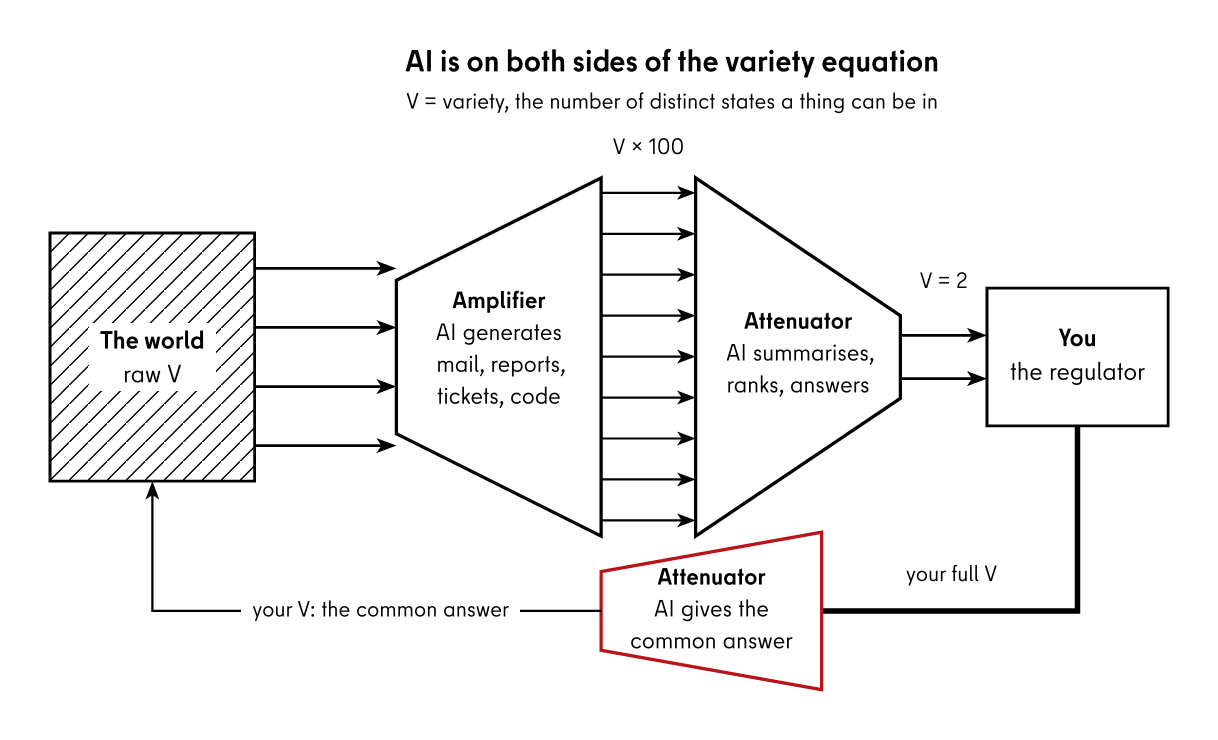
But what is the point? This seems performative. The same tools that amplify the variety are being sold to us to reduce it. So who wins? If there is no productivity goal outside this loop, then, at least in the short term, only the companies selling the AI.
Beer would probably call it good if the attenuation helped us achieve our own goals, ones we designed ourselves rather than the companies making the AI. Unfortunately, there are reasons to doubt that this is the case. Have a look at the figure below:
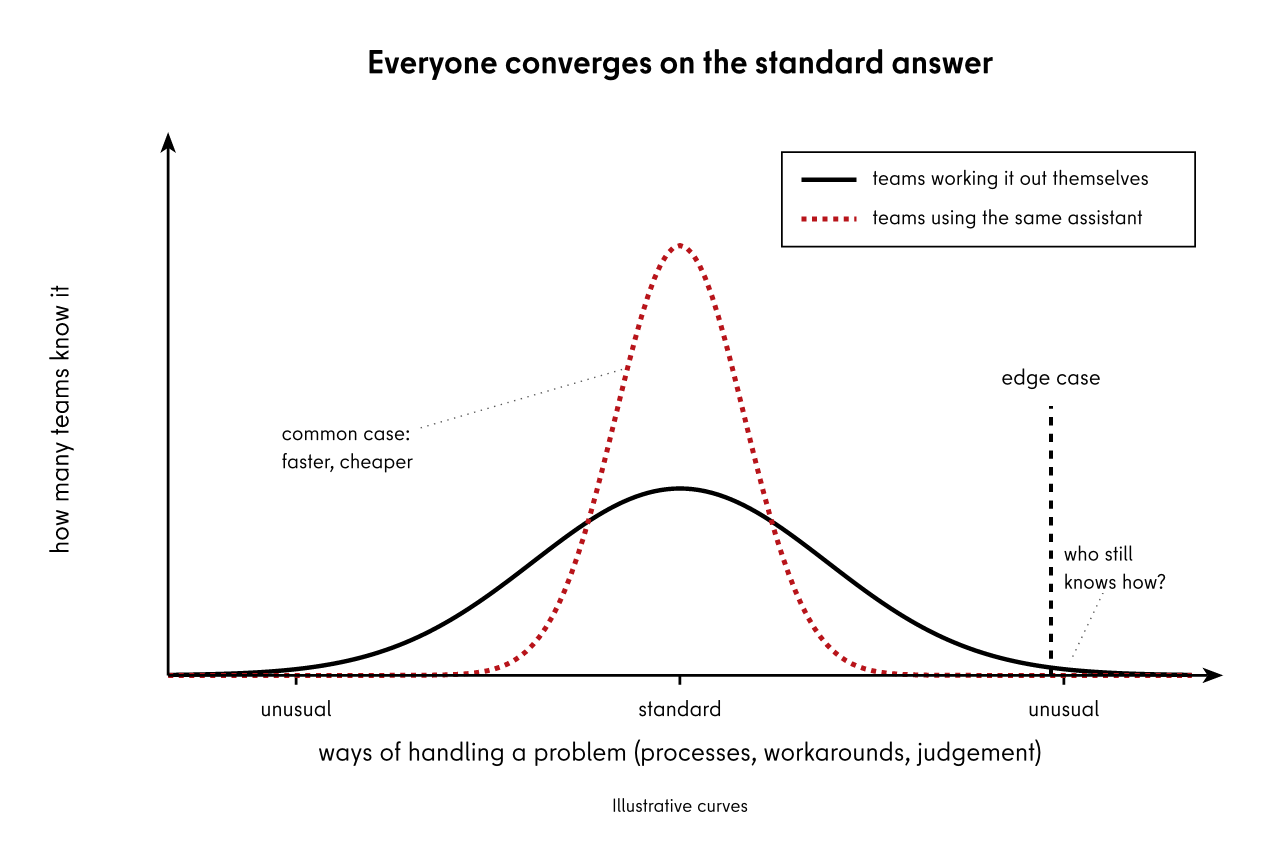
An organisation has a limited number of ways of handling the problems it faces, and to be viable it has to match what the environment throws at it. When teams rely on AI, which by its very design tends to give the most common answer, edge cases fall out, and teams converge more and more on the quick fixes that are “common sense” for the AI. If you have read Taleb, you will see how this makes the system more fragile, and how a black swan could break it.
A study of software developers shows a further negative effect. Experienced developers used AI to work on complex codebases they knew well. Not only did AI make them slower, but the study also showed a gap between how productive they expected (and felt) to be and what was actually measured.1
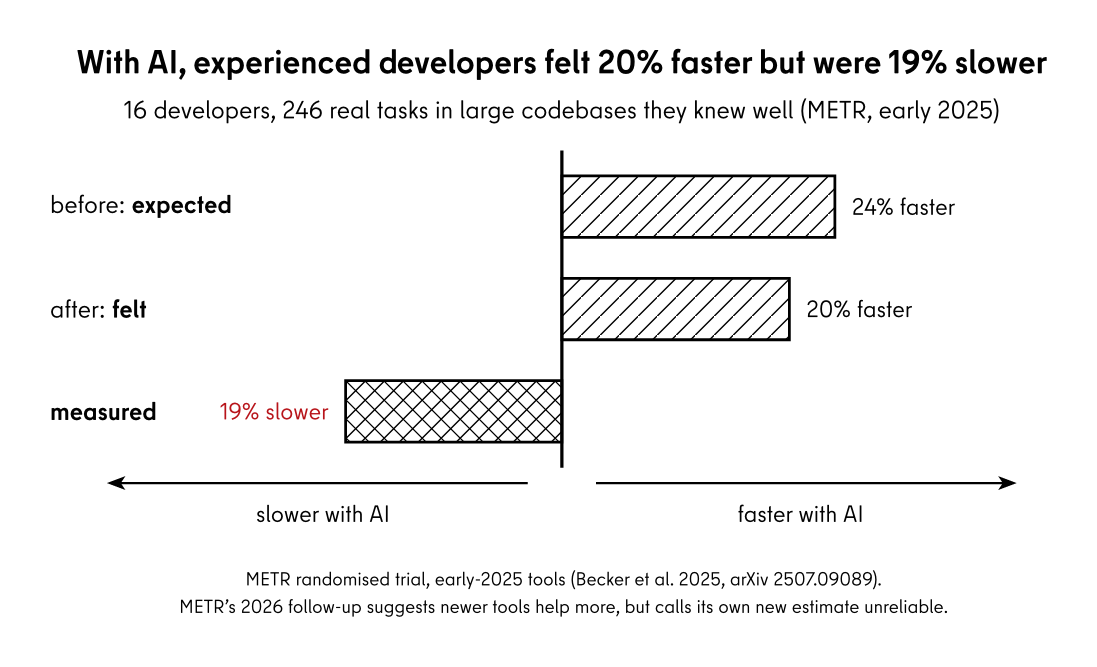
Results like these should serve as a warning. I think we should always “steer” ourselves, and keep asking whether our work with AI really amplifies our capacity to respond, or instead turns us into meat proxies who do more elaborately and verbosely what was done before. A few questions help. Does AI change the task itself, or just add more noise? Does it fit my specific situation, which might be an edge case, or does it give a generic solution? Will a human use our output productively, and be able to judge it?
Notes
1. To be fair, this study used the tools of early 2025, and the field moves fast. In February 2026 the same researchers published a follow-up with newer tools and a larger group of developers. They think developers are probably sped up by AI now, but they also call their new estimate unreliable. One of the reasons is that many developers refused to take part, because they no longer wanted to work without AI at all. ↩
Resources
- Simon, Herbert A. “Designing Organizations for an Information-Rich World.” In Computers, Communications, and the Public Interest, edited by Martin Greenberger. Johns Hopkins Press, 1971.
- Beer, Stafford. Designing Freedom. CBC Massey Lectures, 1973. House of Anansi, 1974.
- Becker, Joel, Nate Rush, Beth Barnes and David Rein. Measuring the Impact of Early-2025 AI on Experienced Open-Source Developer Productivity. METR, 2025.