

Why Requisite Variety?
Why this blog is named after Ashby's law
Why choose "requisite variety" as the title of my blog? Simply because keeping complexity manageable is at the very heart of what I am trying to do with my work, both in data and AI and in progress studies.
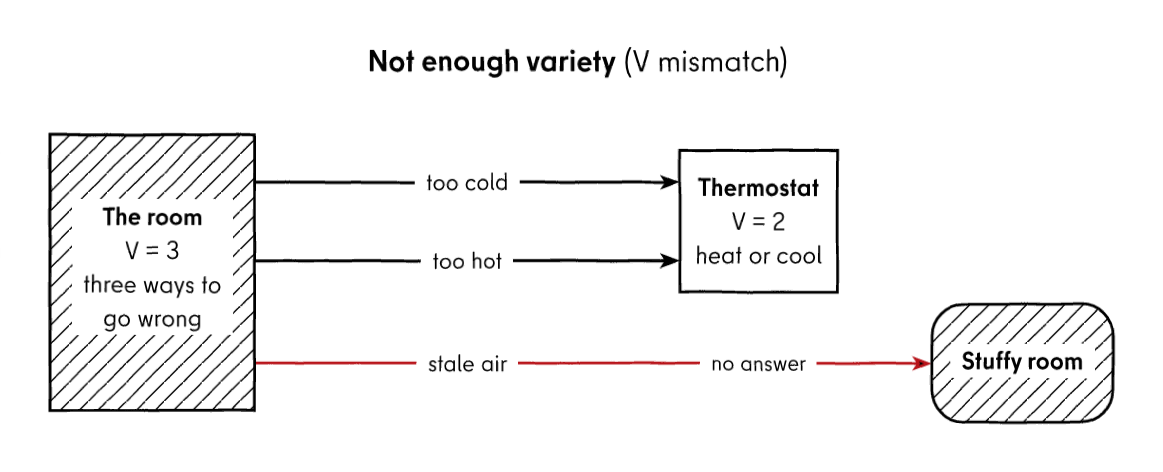
Ashby's law of requisite variety, from 1956, says that a controller can only hold a system steady if it has at least as much variety as the disturbances it faces. Variety (V in the diagrams below) just means the number of distinct things something can do or be.
Let’s have a look at a thermostat. There are just two things it can do - increase temperature or decrease it. But if we decide to add a new dimension of complexity to the situation, such as ventilating the room, this setup will malfunction, since it has just these two states.
It sounds like a simple idea, but once you understand it you start to see it everywhere. As José Pérez Ríos says in my documentary on Stafford Beer: "Learning cybernetics is like having an eye surgery, removing a cataract." I would argue that understanding this principle is the first step to dealing with complex systems. Have a look at what happens when there is not enough variety in us:
But if we manage to both attenuate the variety of the problem and amplify our own (Stafford Beer called this variety engineering), we are in a much better situation.
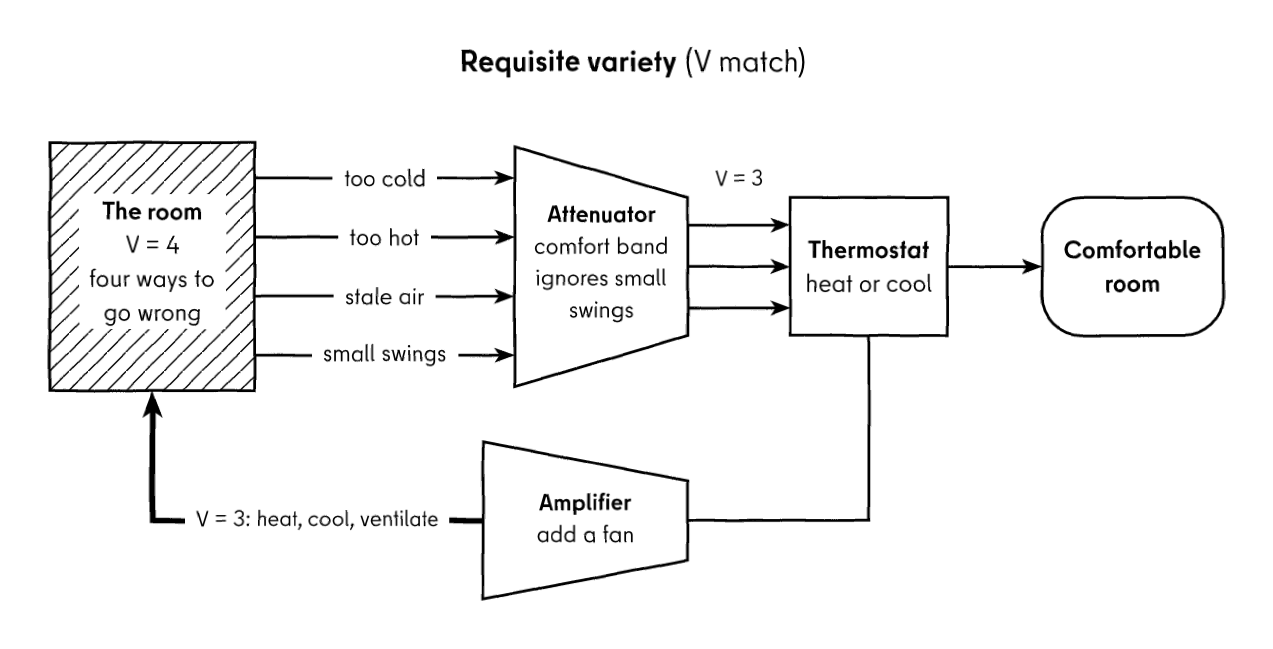
My job has always been to do that, hence I think it is a suitable title.
Resources
- Ashby, W. Ross. An Introduction to Cybernetics. Chapman & Hall, 1956. Chapter 11 covers requisite variety.
- Beer, Stafford. The Heart of Enterprise. John Wiley & Sons, 1979.